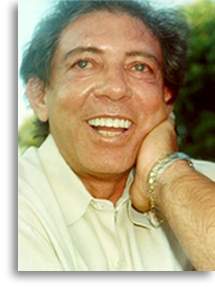
John of God at the Omega Institute

Each morning we started with the prayer of Caritas: [quote]God! Our Father, who is power and goodness, provide strength to those who experience pain and anguish. Give light to those who seek the truth! Fill the human heart with love and compassion! God! Give the traveler the star that guides, solace to those in pain, and rest to the sick and weary! Father! Give the guilty repentance, the spirit the truth! Give the children guidance and the orphans a father. Lord! Let your goodness encompass everything that You created! Clemency, my God, to those who do not know You. Hope to those in pain. Let Your Will allow the consoling spirits to spread peace, hope and faith everywhere! God! May a single ray of light, a spark of Your Divine love blaze the Earth! Let us drink from the fountain of that infinite and fruitful goodness and all tears will be dried and all pain lessened. A single heart, a single thought will rise up to You, like a cry of gratitude and love! Like Moses on the mountain, we await You with open arms. Oh Almighty! Oh Greatness! All Powerful, All Beauty! All Perfection! And we wish in some way to receive Your mercy. God! Give us the power to help progress that we may rise up to You; Give us pure charity, give us faith and reason, give us simplicity that will make our souls a mirror on which Your image should reflect! Amen.[/quote]

And then we would say the Lord's Prayer

[quote]Our Father, which art in heaven, hallowed be thy name; thy kingdom come; thy will be done, in earth as it is in heaven. Give us this day our daily bread. And forgive us our trespasses, as we forgive them that trespass against us. And lead us not into temptation; but deliver us from evil. Amen.[/quote]

And then we would recite Hail Mary

[quote]Hail Mary, full of grace. Our Lord is with thee. Blessed art thou among women, and blessed is the fruit of thy womb, Jesus. Holy Mary, Mother of God, pray for us sinners, now and at the hour of our death. Amen.[/quote]

I am writing these down because, except for the Lord's Prayer, I did not know the other two of them. Each of the three mornings we would have a series of welcome hellos/testimonials. Here are some of the fabulous tidbits that I jotted down.

From cheerful Norbeto, who started every talk with "Today is the best day of your life!" with a huge smile and his Brazilian accent!

[quote]Make a new way for your life. Smile more, sing more, happy more. Say this is the best day of my life! You respect your belief - your belief your life Love more We receive a body, after life we will continue as spirit as it once was. Sickness is an opportunity to understand we are spiritual beings. We came to the earth to understand we are spiritual beings. This is the greatest opportunity, loving all of divine creation from a space of humbleness. The life is very simple: what you believe is the life. It is important to talk about health and not about sickness. Between 10-11 is the "humor time" of night to sleep and 70% of us are on our computers and not getting that good "humor" sleep. There are 3 divine remedies for our health: 1) sleep from 9 pm-5 am 2) eat good food 3) life is what we perceive of it If I perceive a life of joy I become an enthusiast. Of you think you have what you need than you will have it. Repetition is important. Transform thoughts and beliefs into action. (I have joy, I have vigor.)  Change your internal dialogue. Being angry is a brief stint of insanity (when you are far from the Godlike mind). We can only take that step forward when we understand our fellow limitations of human beings. Congratulations on your existence! We are spiritual beings and we have a body. Faith is to believe what you do not see. The reward for faith is to see what you believe. We are what we think. On the mental level you can decide to laugh and smile. I give in this moment all things that upset me to God - release worries, hardships etc. And I receive from you God all that I need to say thanks to you God. Nobody can touch me unless I permit it. We achieve what we desire but we achieve much more what we are afraid of because we spend so much time talking about what we are afraid of. [/quote]

The morning of the second day Dr. Wayne Dyer spoke to us about his experience with receiving long distance surgery the previous spring after he was diagnosed with Leukemia. He speaks extremely well and I am going to seek out opportunities to hear him in the future. Dyer recited two poems. One by Samuel Taylor Coleridge and one by Tagore - the Indian Pulitzer Prize winning poet from 1927, and WOWZA.

[quote]I came out alone on my way to my tryst. But who is this that follows me in the silent dark? I move aside to avoid his presence but I escape him not. He makes the dust rise from the earth with his swagger; he adds his loud voice to every word that I utter. He is my own little self, my lord, he knows no shame; but I am ashamed to come to thy door in his company.[/quote]

Here are some of my notes from hearing Dr. Wayne Dyer speak.

[quote]EGO - Edging God Out It is in the transcending of that ego that all healing takes place. [After his stitches came out from his intervention with John of God] I see love in everything I encounter. You see with a capital S. A host to God or a hostage to our Ego [from a Course in Miracles]. [/quote]
On Tuesday I received divine intervention from the entities and I could feel it in my abdomen, neck, spleen, and liver. On Wednesday I received divine intervention from the entities and I could feel it in my heart chakra and my brain. I was in a fog until about thursday morning and I feel as though I have received surgery - that I am recovering. Stitches are coming out tonight and tomorrow and we have 34 more days of the protocol. I am so freaking grateful.

Thank you John of God for your life of service.

Thank you for those who led me to you.

Thank you for my abundant health.


The List (so the Universe knows what I want)


Hello Universe! Here is my list (written and refined while meditating/zoning out/drinking in the cosmic bliss of John of God). I also sculpted this in the tradition of Zingermans vision writing (it is strategically sound, documented, and I am sharing it with the world).

[unordered_list style="star"]

  • Marriage - gratitude
  • I Dreamt of Sausage - $$ beyond that which I have spent, interest continuing beyond this time of intense publicity.
  • Real Time Farms - fervour, accolades
  • Health - vibrancy, 47 on the urine test
  • Balancing Elephant Farm - sustains, amuses, captivates us for years
  • Rhinebeck - community of love
  • Family - healthy, close

[/unordered_list]

Hello World!

Mastering my mindset...(requires constant vigilance)

A dear friend of mine wrote to me over a year ago an email about my book - and I knew it was important. I would read it and think of what it meant and read it again. I wrote out her email onto two post it notes, now folded and wrinkled. Tape is frayed on the edges from where it used to attach onto my computer monitor. This is what she said to me: "Dear Corinna, Your book is very different from other cancer survivors. Young. Refused to say yes, etc. The acceptance of your U of M doctors as you groped. Unusual in many ways. When you write don't follow formula for these kinds of books. Many r terrific. But they are not for your audience or not as much. Be clear about what is different. This is your story. - C. 6/22/10"

So here I am, over 14 months later - trying to work with my great publicist found through Balboa Press to put together a succinct intriguing 150 word phrase to pull people in. I wrote over 80,000 words and I am distilling that down to 150.

Then I struck on this phrase - "this book shows the myriad ways her relationship to the world is transformed because she transforms how she looks at the world." Which is remarkably providential because my inspiring and luminary friend Kelvin Ringold of Intensely Positive started recently signing off his Vitamin K  daily inspirational goodies with "Master your mindset and master your life."

Mastering my mindset takes work and awareness. It takes constant vigilance! (thank you JK Rowling). It takes a sense of humor and it takes patience.

I began the process when I wrote my book, going through my old journals and rereading what I wrote at the time, it continued when I read Eckhart Tolle. It continues every day I catch myself thinking a thought that is not so nice, being angry with my body for not being able to do something that it used to be able to do well (or at least that I remember as being so).

Stupid chemotherapy, I used to do this so easily.

I caught myself yesterday as we rushed through 5 sun salutations as quickly as we could in yoga class. I stood there with my heart POUNDING in my chest, lungs burning, dizzy, eyes closed and my first thought was to hate - HATE - (a word of huge yuckiness) my body. Then my awareness caught up.

Corinna! I have lungs that can burn and a heart that can thump. I have a beautiful body that is working hard to do what I ask of it! Be grateful for the taste of iron in your blood - I am ALIVE!

Thank you world, I am alive.

Ann Arbor Adieu on Annarbor.com

On Sunday, I watched two of my "girls" deflowered by a rooster.

I had been feeling wary of this upcoming event and my role as a chicken pimp, but we had no choice. Either we were going to kill the girls and bring them with us to our temporary rental home in the freezer, or we were going to give them to friends who have many chickens in their flock.

It seemed highly ridiculous that killing a living creature was deemed better than letting nature take its course – so our girls were introduced to their new flock. Five minutes later, two of our girls were ruffling their feathers, seemingly unperturbed by the 10-second coitus.

Saying goodbye to our chickens was the last in a long list of adieus as we leave this wonderful town.

We have lived here six years, and I feel I only know 40 percent of what makes Ann Arbor wonderful, especially in the realm of food.

As food is the only carnal thing humans can do in public, I salute all those who pursue this world. I am grateful to you all. This world of feeding our bodies, our health, our souls.

Here is the article on Annarbor.om

What I didn't write in this article was the sense of vertigo that accompanied the list upon list upon list as we sold our house and left. Leaving a town where one has lived for 6 years, leaving a town where one went through residency, through oncology office visits, and through falling in love (with the food world, with one's husband, with the reality of the miraculous).

Onward to the next adventure!

Encomium for the USDA and the glory of the DC/Baltimore foodworld!

(Other than being a good word for freerice.com, encomium denotes a song of praise.)

Just in time for a perfect week of spring weather, I visited DC (my hometown) and Baltimore to walk up and down the Mall, visit the Department of Agriculture (USDA), talk to restaurants in love with transparency, take pictures of markets, and explore the food changes that have happened to my town in the past 7 years (since I left).

It was a dizzying week because the food world in the capital area has exploded. Farm to fork restaurants are sourcing from a myriad of new and vibrant farmers markets, rooftop gardens are supplying veggies to restaurants across the street — fed by compost from the very restaurants, and the USDA not only hosts a farmers market onsite — they shared the locations of all markets nationwide.

I began the week talking to Amanda Eamich, Director of New Media at the USDA. Eamich was able to highlight and share several of the tools the USDA has provided to help inform policy and the public. The Economic Research Service (ERS) section of the USDA has built two amazing online tools to help pinpoint food availability and broader “determinants of food choices and diet quality.” The Food Desert Locator shows all areas in the country that are more than 1 kilometer from a source of healthy food — you might be surprised at certain locations. The Food Environment Atlas enables you to view on a map a plethora of food choice determinants. Factors such as the 2008 sales tax from soda vending machines, the 2009 low-income preschool obesity rate, or the 2006 relative price ratio of green-leafy veggies to starchy veggies each jostle for your attention in this captivating tool.

Not only is Eamich working with those two tools, she works with the blog. That is right, the USDA has a blog. And what a blog it is. As the tagline says: “United States Department of Agriculture: Reaching Out, Every Day in Every Way.” There are updates about the First Lady’s Let’s Move Campaign, the People’s Garden expansion to overseas, Chef’s Move to Schools, ‘Know your Farmer, Know your Food’, and even what Smokey Bear has been up to. I walked away feeling our government has truly a vertiginous collection of disparate programs and initiatives all designed to provide access and education around healthier food in “every way.”

The next four days were a whirlwind of visiting restaurants in DC and Baltimore. Chef Rob Weland of Poste Moderne Brasserie showed me his courtyard garden in the Hotel Monaco — where you are literally eating next to a tomato plant growing in a pot. Chef Spike Gjerd of Woodberry Kitchen gave me a tour of his kitchens, including the sausage aging room (all butchered and made in house, naturally) and the wall of in house preserves (the last of the 2000 pounds of tomatoes from 2010 and the first jars of 2011 ramps in evidence). Chef Winston Blick of Clementine spoke of providing compost to Hamilton Crop Circle - a rooftop garden across the street - that, in turn, returns vegetables to his customers. I met with Nic Jammet, one of the founders of Sweetgreen, a sustainable build your own salad/yogurt phenomena that has rocketed to ten locations in the last 3 ½ years. I look forward to attending their Sweetlife Festival next May.

When not gawking at menus I was able to visit two farmers markets in the middle of town — and I mean in the middle of town. One is 3 blocks from the Mall and the other is 3 blocks from the White House — producer only, crowded, and diverse (orchids, wood fired pizza, and the first strawberries of the season - glorious). Thank you FRESHFARM for your great work creating pedestrian villages in downtown DC.

My last day started with a meeting with Debra Tropp and her team of committed farmers market devotees in the Farmers Market and Direct Marketing Research Division of the USDA. Food Tech Connect recently posted a great article describing the need and uses for the Farmers Market Directory in a conversation with Tropp. As a former farmers’ market manager, I remember last year feeling honored and vindicated to fill out the survey to populate the directory. I was doing something important when the government asked me the number of people who came to the market or whether we accepted Bridge Cards — my little stretch of pavement 18 weeks of the year became part of something large and meaningful.

Little did I know my 15 minutes filling out the survey would be transformed into a resource available to the world. The information in the Farmers Market Directory is what first populated Real Time Farms database of markets.

The cherry on my Sundae week was meeting with Gretchen Hoffman of the American Farmland Trust - the vanguard group who worked in the 1980s to create and implement conservation easements for farmland. A few years ago, Hoffman spearheaded the America's Favorite Farmers Market Contest, voting starts June 1st!

A week of good food, good company, and good learnings - what more could one want?

Here is the article on Real Time Farms!

(I would also like to appreciate Wendy Wasserman of the USDA, without her help and good sharings my week would have been very different.)

Tangy Parsley dressing to sparkle your winter eatings!

For the past four months we have been chomping on fresh greens courtesy of our CSA from Shannon Brines of Brines Farm. Curly baby kale, dark soft spinach, tall elegant arugula, and delicate salad mix are grown in his hoop houses. Sometimes he adds squash, potatoes, beans, or frozen tomatoes to fill out the selection (based on sunlight and temperature). I am always looking for a new way to add sparkle to the ballast of our weekly diet. I was served this dressing by a friend who had just attended a cooking class entitled “Reclaim your energy: Adrenal support cooking class” by the National Gourmet Institute for Food & Health in NYC. The recipe was entitled “Dark Leafy Greens with Tangy Tahini Dressing” - I think the three of us groaned aloud when we first took a bite.

I have reenergized my kale chomping excitement - in fact, it goes beautifully on everything. (I have been putting it on toast under a poached egg.) Here is the dressing recipe (that which elicited groans at first bite at the dinner table):

  • ½ cup tahini
  • 2 tablespoon shoyu (soy sauce)
  • 2 tablespoon umeboshi vinegar (or ume plum vinegar)
  • ½ cup parsley
  • 3 scallions
  • ½ cup water

In a food processor, combine tahini, shoyu, umeboshi vinegar, parsley, and scallions blend together then add water and blend again.

Here is what I have been doing (the garlic adds more punch than the scallions, but still groanworthy):

  • 1 heaping spoonful of tahini
  • 1 heaping spoonful of almond butter
  • a 6 second pour of tamari
  • a 3 second pour of umeboshi vinegar
  • a 3 second pour of rice wine vinegar
  • 4 garlic cloves
  • one bunch of parsley
  • water to taste

I have been blending the above and then adding water to the desired consistency. The less water you add, the more of a paste, the more water you add, the more of a dressing.

Enjoy!

Photo courtesy of Cara Rosean of Real Time Farms, thank you Cara!

Here is the article on annabor.com.

What is the abomination of McDonald's "oatmeal"?

Borden - McDonalds bowl of oatmeal from their website

This is the bowl of oatmeal shown on the McDonalds website page - a page that has its own jaunty "oatmeal" tune.

Why do we care that McDonalds has introduced "oatmeal" with more calories than their hamburger and with more sugar than a Snickers bar? I put "oatmeal" in quotes because, according to Mark Bittman's How to Make Oatmeal: Wrong, the product should be described as "oats, sugar, sweetened dried fruit, cream and 11 weird ingredients you would never keep in your kitchen."

As of Saturday, the article has lived in the top 10 emailed list for The New York Times since it was published on Tuesday, February 22. Apparently, a lot of people care.

My question is why? Are they preaching to the choir? Or do people actually think in this day and age there is anything healthy about walking through the fabled double arches?

Whether it be SuperSize Me, Eric Schlosser's #1 bestseller Fast Food Nation: The Dark Side of the All-American Meal, or a simple read through McDonalds menu ingredients online. We all know McDonalds is not healthy, yet stories continue to be written, emailed, and commented on - detailing the exact nature of the unhealthiness.

Conrad's "the fascination of the abomination" comes to mind, our inability to look away from a train wreck. However, the true abomination is this. Everyone knows McDonalds is unhealthy and people go there because they have no choice. They have no choice, because as Michel Nischan of the Wholesome Wave Foundation put it at the TEDx food conferece, "they can't afford" real food.

According to the Fair Food Network, 92% of all Detroit food stamp retailers offer no fresh fruits and vegetables. For an urban food desert like Detroit, and for the rural food deserts in Iowa, the dried fruit in McDonalds "oatmeal" might be the closest a child gets to biting into an apple. That is the real abomination, and worth talking about.

Here is the article on annarbor.com.

Kale chips are sublime

Last season, I was tired of kale. Tired of sauteing leaves, tired of putting green stalks in soup, tired of the dense chewiness, tired of hearing how good it is for me (high in flavonoids, blah blah). So, come late last October, I choked down the rest of the leaves, relieved to be finished with that duty for the season.

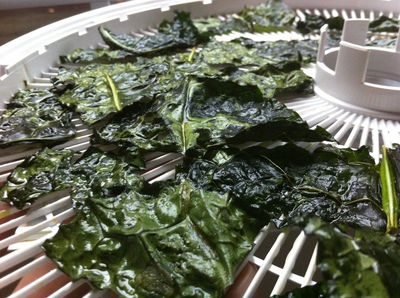
Borden - kale chips

A farmer friend of mine had told me that kale would survive the winter and come back hardy and healthy in the spring if I cut off the dense stalk right at ground level. He was right. We have several thriving kale plants from last year’s stalk. Unfortunately, the passing of months did not diminish my kale fatigue and I have not harvested much of any of this year's leaves.

Yet here we are again, a new October, and I knew I needed something new to try to help me take my kale medicine before the frost.

So I tried a variant on a kale chips recipe I found in the world of dehydrators/raw food. I can honestly say that it was the closest I have ever come to eating a plate of food like an 18-year-old-boy eating a pizza (there was no chewing involved). I inhaled these delicate green chips.

Kale chips are crunchy, intensely subtle, salty, warm and wonderful. There is not any of the bitter flavor associated with kale when prepared this way. As an even better bonus the chips are super fast and easy.

When I did a bit more research I learned that you can bake kale chips in your oven for those who don’t have a dehydrator. Instead of dehydrating for two to three hours at 95 degrees F, you can pop them on a baking sheet for 20 minutes at 300 degrees F (or until crisp).

Here is the recipe I used for my chips.

- Cut four leaves from plant.

- Remove stem and cut into large pieces.

- Toss in a bowl with 2 tablespoons apple cider vinegar, 1 tablespoon olive oil and sea salt.

- Let sit for 10 minutes to wilt a bit from the liquid (one recipe I found said to wait an hour)

- Place in the dehydrator/baking sheet.

- When they are crispy and warm, they are finished.

- Devour them as fast as you can before your friends learn how good they are.

(I will end with a thank you to the earlier maligned plant.)

Oh kale, of cruciferous and flavonoid fame, thank you for being such a delicious chip. You pulled me in with your sturdy frame and healthy fronds, and though I strayed from eating your flesh, I am once again pulled back into the fold of loving you – with your sea salt, oil warmth beguiling me in. All hail kale!

Here is the article on annarbor.com

(March 2015 update: Here is an updated page from the great folks at Health Ambition about the health benefits of kale - with recipes too!)

Storing harvest bounty: canning vs. dehydrating

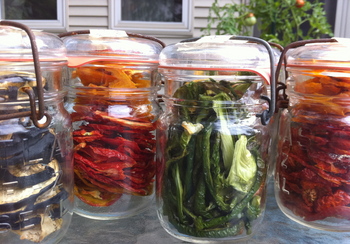
Borden - jars of dried veggies

Last winter I received Mary Bell’s Food Drying with an Attitude: A Fun and Fabulous Guide to Creating Snacks, Meals, and Crafts - and I put it aside because I did not have a dehydrator. Like last year, I started this season with drying tomatoes in my oven, but the tomatoes take two full days to dry in the oven at 200 degrees. So I bit the bullet and bought an electric dehydrator - one built for the task.

I purchased the dehydrator week ago, reread all of Bell's engaging and intriguing book, and I have not turned the machine off since. I pack slivers of color, once hefty tomatoes and gleaming eggplants, into airtight jars and debate the pros and cons of dehydrating vegetables vs. canning vegetables. Here are my thoughts so far - I look forward to hearing yours.

Dehydrating pros

- Food is considered raw when dehydrated below 105 degrees (because it maintains enzymes and nutrients that are leached by higher temperatures).

- The labor involved is minimal. I cut the vegetables at night and pack them into jars in the morning.

- The equivalent ingredients take up less room when dehydrated than when canned.

Dehydrating cons

- Dried fruit and vegetables do not last as long as canned items.

Canning pros

- The recipe is finished when you open the jar, as opposed to drying the basic ingredients, and then making a recipe in the winter. (This could also be considered a con.)

Canning cons

- The labor involved is focused, hot, and continuous. From cooking the sauce, to the hot water bath, to preparing the jars - unlike dehydrating, it does not happen while you sleep.

This last point for me is the crux of the matter. A food preservation technique that is self-contained, creating results while I sleep, is incredible. To me, that is a winning food preservation technique.

Here is the article on annarbor.com

A locavore discussion: why preserve tomatoes for the winter?

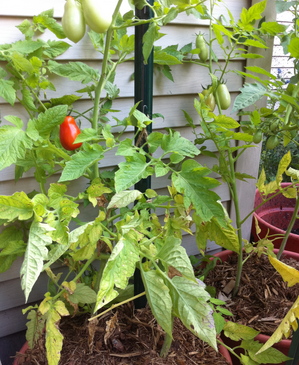
Borden - tomato plant

I have been scratching my head recently over a recent Op-Ed piece in the New York Times, called Math Lessons for Locavores, by Stephen Budiansky. First, I felt kinship with the author when he agreed with what I learned when I did my organic berry jam cost comparison article - namely, the efficiencies involved in shipping food long distances, “adds next to nothing to the total energy bill." Then, he goes on to posit that household energy usage is the true culprit, accounting for “32 percent of all energy use in our food system, the largest component by far."

The Op-Ed piece concludes with the same argument I learned from economics in high school; we should “grow lettuce, oranges, wheat, peppers, bananas, whatever, in the places where they grow best and with the most efficient technologies – and then pay the relatively tiny energy cost to get them to market, as we do with every other commodity in the economy." This is his rationale for being wary of the terms “food-miles" and “sustainability" - which are rapidly joining “organic", “natural", and “free-range" as words that connote gold and denote tin.

He gives very convincing evidence that the energy used in transporting grapes from Chile can be less than the energy used for the extra freezer your family buys to freeze your local rhubarb. But his fallacy is assuming that we need, as a nation of Americans, to be eating those grapes in March.

For the last three weeks, at the Westside Farmers' Market, I have overheard customers ask the vendors whether or not they have any lettuce to sell. I think this is because tomatoes are ripe. At some point in our national assumptions, a burger became married to “lettuce and tomato." The question, “would you like lettuce and tomato on that?” became coupled together and ingrained into our national consciousness. Therefore, when you go to the farmers market and see tomatoes, our brains look for the lettuce - “it must be here! How can I make a proper burger without it?" But the two vegetables are not ripe at the same time: lettuce typically arrives in the spring and tomatoes in the fall.

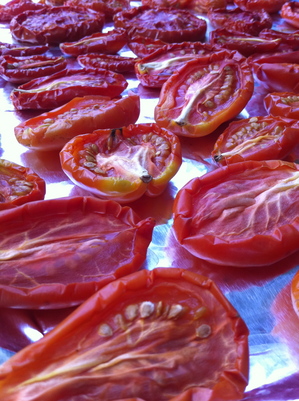
Borden - dried tomatoes

Bananas on our breakfast cereal, apple pie in May, watermelon for the 4th of July picnic, orange juice and coffee in the mornings, chocolate for Valentines Day, lettuce with tomatoes for BLTs in March ~ many food pairings in our American culture assume cheap oil, willing trading partners, and organized large-scale transportation.

Our supermarkets groan under the volume and the diversity of our food choices - during all seasons of the year. That abundance of choice and quantity is not serving us. According to a recent article in Scientific American, Americans throw away between 25% and 50% of all of the food we produce for domestic sale and consumption. A 2009 study from the National Institute of Health concluded, "US per capita food waste has progressively increased by ~50% since 1974 reaching more than 1400 kcal per person per day or 150 trillion kcal per year. Food waste now accounts for more than one quarter of the total freshwater consumption and ~300 million barrels of oil per year."

You only throw away that which you do not value. The NIH study tells us that Americans are a spoiled nation when it comes to food. There are 6.8 billion people in the world - 1.02 billion of them are hungry.

One out of six people is hungry, yet we are overwhelmed with a relentless supply of bananas and lettuce and avocados and apples all seasons of the year. It is understandable that our national barometer for what to expect at the market has been skewed. It is understandable, and a huge tragedy, that we throw so much food away.

Why preserve tomatoes for the winter? I preserve my tomatoes for the winter to help me reset my internal barometer as for what I should expect on my burger.

Here is the article on annarbor.com.