
Letter to my Children: Changing a Spoken - INTERRUPTING - Habit
/Dearest Beloveds,
Recently I had this conversation with E. “I am trying to stop myself from interrupting. I think it is a terrible habit.”
“Well, I don’t think it’s terrible. My mother interrupts to change the subject. You interrupt because you anticipate the next thing I am going to tell you in the story - and share.”
“Oh E, you are too kind. Another way of saying that is that I am too impatient with you to finish your own story. I predict what you are going to say to show off that I know where you are going. Blerg.”
“Well, I guess that is one way to look at it.”*
Argh my dearests, my darlings. Changing habits is hard. I have such a well worn grove in my psyche of jumping into other people’s stories and delivering the punchline. I don’t know when I started doing this. But I am trying to stop.
Trying to stop means I am at the stage where I am noticing. I am noticing mid flow as I finish a sentence, complete a thought, anticipate the ending to a tale.
I interrupt AGAIN. “Oh sugar! I am trying not to interrupt. I am sorry.” Then I find myself biting my tongue for the rest of the interaction as my my brain tells my body NOT TO interrupt!!!
Because the Universe is amazing, recently Josh Schrei of the Mythic Body elucidated the Vedic understanding of language. An understanding that parallels very closely (not surprisingly) what Maharishi Mahesh Yogi says about where thoughts come from. Maharishi explains that thoughts expand like air bubbles from the bottom of a lake of pure consciousness getting bigger and bigger until they “explode” on the surface of our conscious awareness.**
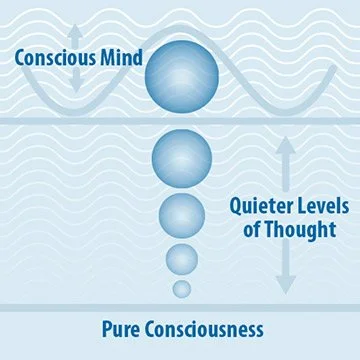
Schrei talked about the four layers of language described by the Tantric traditions. Aligning ourselves with Maharishi’s metaphor: Para is the bottom of the lake - pure intention, the power of Creation itself, Oneness. The thought rises up to pashyanti - where the thought is described by Robert Svoboda in his article 4 Degrees of Human Speech as, “perceptible but not yet particularized.” It is where you feel something but it is not yet into words in your brain. I feel a lot of the communication that happens between babies and their parents happens in this space. The time in pashyanti defines and solidifies the thought as it travels up in the waters of consciousness.
Right below bursting forth into spoken language is madhyama - the subtle sound of the word manifesting as mental dialogue/internal monologue.
Finally, language bursts onto the scene with vaikhari. Audible sounds articulated with the breath, tongue, lips and teeth. The word manifest into the vibratory soup of audible sounds.
To shift my interrupting habit - I need to expand the time my words spend in madhyama. Catch myself there before words burst out into the conversational space.
I have been focussing on this since early July and it is still very much a work in progress. It is not an instantaneous thing to shift a habit. In fact, I think I need some help.
Good thing there is a whole wealth of information out there from sages and wise folks who have been dealing with human issues for a LONG time. Somatic practices that create friction in our bodies to shapeshift ourselves into new habits.
So here we go. I found a Kundalini meditation entitled For Thinking Before You Speak. Aka, for bringing awareness to the Madhyama level to pause my enthusiasm for the conversation in the form of an interruption. According to Kundalini it takes 40 days of continuous practice to break a habit, 90 days of continuous practice to establish this new habit, and 120 days to confirm the new habit.
Beloveds, the effort it is taking to shift this one irritating habit of mine is rather galling to your mother. I wish there were a way I could just wave a magic wand and fix the issue. But it is going to take time, and effort, and consistency. It is going to take a bit of umph.
It is going to take me three minutes a day of sitting and committing to saying Maaa, Maaa, Maaa, Maaa like a heartbeat, in a quick rhythm, with my hands in Gyan Mudra. It is not physically difficult - none of these life changing things are - it is just committing to the practice of DAILY DOING IT (as I shouted about in 2018).
I think of all of the things that I would like to be shifted in our global habits - consumption, extraction, violence, etc etc. and strangely, somehow, the time and work I am putting into this interruption rewiring makes me feel better about our body politic.
Our society is fractured on many levels. Me jumping up and down to FIX THINGS NOW is not helping me or anyone else. In fact, it parallels the same energy I have when I interrupt someone else’s story.
The micro, my personal experience in this body sitting here, is a distillation of the macro, the sociocultural zietgeist. Micro work ripples to the macro.
The point, my children, is that I can only control my own self. And that change, real embodied change, takes time.
Embodied change takes time.
So…
Maaa, Maaa, Maaa, Maaa.
*Another friend - who also has a penchant for interrupting - says. “I like it when you interrupt, it feels like we are constructing a conversation together. Collaborating.”
**I found a video, probably recorded before I was born, of Maharishi’s description. The first 1:10 of the video is quoted below - the rest is a description of Transcendental Meditation.
A thought starts from the depth of consciousness. As a air bubble from the bottom of a lake. As the air bubble starts it is very fine. As it comes up it becomes bigger and bigger and bigger and coming up on the surface it explodes and then it is appreciated as a bubble. Like that a thought starts from the deepest level of consciousness - modern psychology calls it subsconscious - and as it comes up it becomes bigger and bigger and bigger coming up on the conscious thinking level it is appreciated as a thought.


